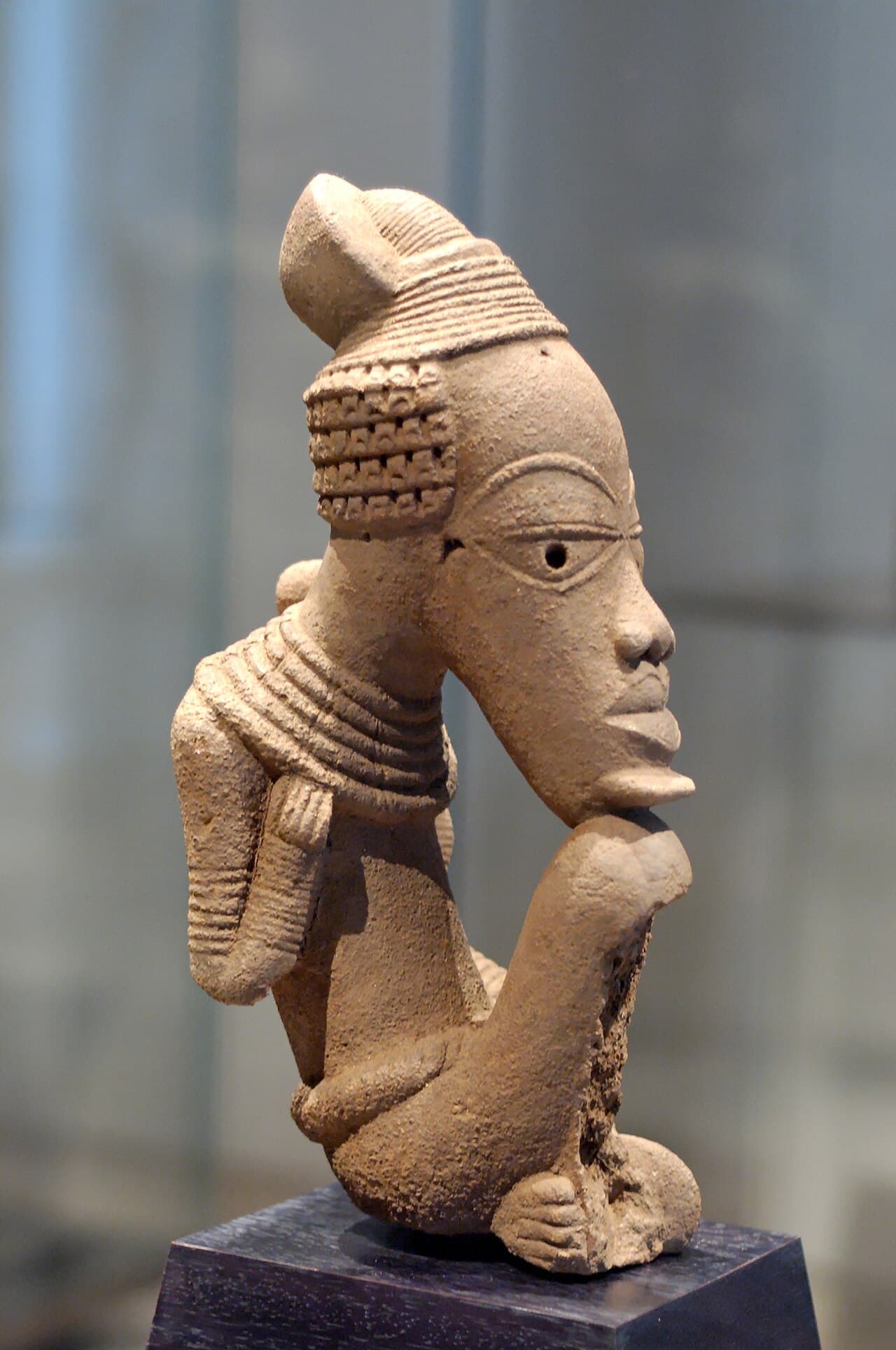
Jos is a young city on very old ground. The terracottas in the museum predate the city by two thousand years and more; the city itself was assembled in a hurry, around tin, in the first two decades of the twentieth century. Almost everything a visitor notices — the street plan, the mix of people, the altitude the British came here for — comes out of that gap.
c. 900 BCE – 200 CE
The Nok
The Nok culture flourished on and around the Jos Plateau, leaving the terracotta figures that remain the best-known Stone Age art of West Africa. Figures began surfacing during tin mining in the 1930s, which is why the National Museum in Jos holds the collection it does.
Contested · Dating is not settled. Britannica gives roughly 900 BCE to 200 CE; other scholarship pushes the beginning back towards 1500 BCE. Treat any single date you see quoted with suspicion.
Tin beads smelted by the Nok show that metalworking on the Plateau is of considerable antiquity. The industry that the British would later claim to have opened was already ancient.
Before 1900
Local workings
Africans extracted tin and iron from the river and stream beds of the Plateau long before Europeans arrived. This is the part most accounts of Jos skip.
1904
Large-scale British operations
The British began large-scale extraction, and the Plateau's tin deposits started to be fully exploited. Active mining ran from about 1905 to 1909 onward, drawing thousands of workers from across Nigeria alongside European specialists.
1915
Jos becomes a city
Jos received city status, becoming an administrative and commercial centre for the British administration. The city's street plan, its cosmopolitan make-up and much of its later trouble all descend from this moment.
1921
Dan Zaria
The locomotive known as Dan Zaria was built for the Nigerian Railway. It now stands on the museum grounds in Jos.
Established in 1938, and by the early 1950s among the most famous hotels in northern Nigeria on the strength of its architecture. It has hosted guests from around the world.
The Berom Educational and Cultural Organization gathered older observances of the farming and hunting year into a single festival held centrally in Jos.
This timeline is compiled from published reference works and is not the product of archival research. Dates before the colonial period especially should be read as the current scholarly consensus rather than settled fact.